
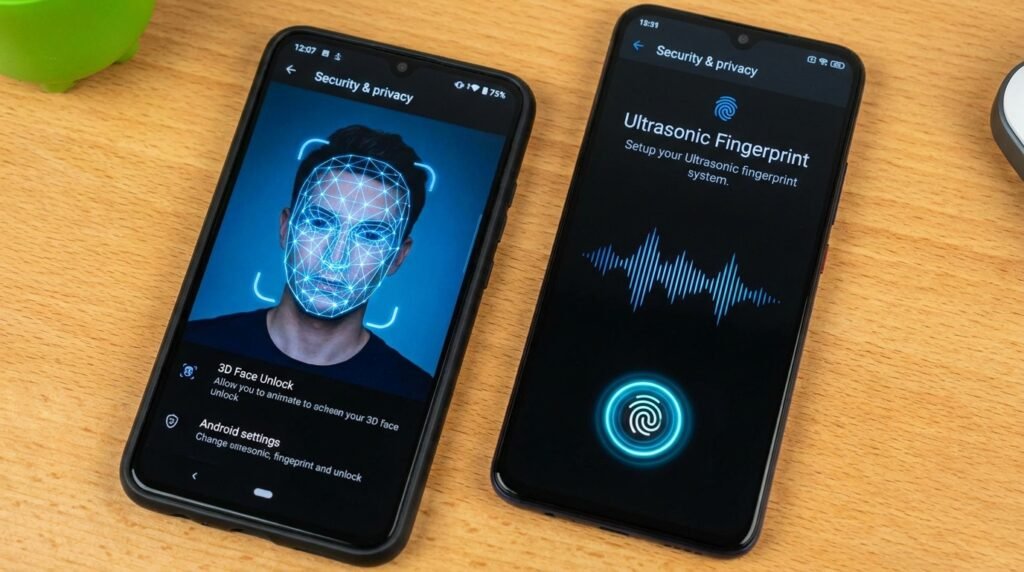
Android Biometric Security: Ultrasonic Fingerprint Scanners vs 3D Face Unlock
Introduction: The Evolution of Biometric Security on Android
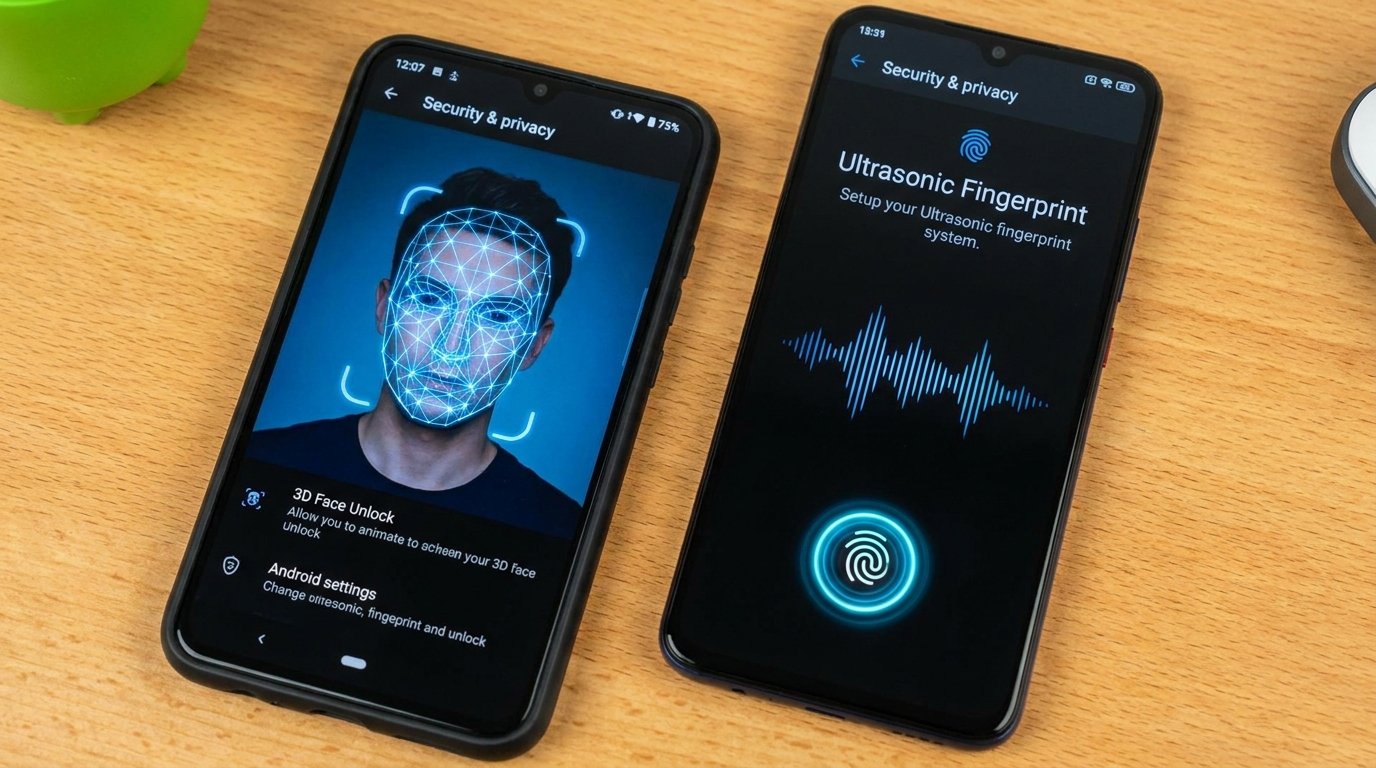
Securing your Android device involves choosing between distinct biometric authentication systems, primarily ultrasonic under-display fingerprint sensors, optical scanners, and hardware-based 3D face unlock. In this technical deep dive, we examine how ultrasonic acoustic waves prevent spoofing, perform in wet conditions, and meet Google’s Class 3 biometric security standards for banking apps.
Biometric authentication has evolved from a novel convenience feature into the foundational anchor of modern mobile device security. Every time you unlock your smartphone, approve a financial transfer in a mobile banking app, or complete an online purchase via Google Wallet, your Android operating system evaluates physical biological markers to cryptographically verify your identity.
However, not all biometric hardware components are engineered equally. Android device manufacturers utilize distinct sensor architectures ranging from under-display optical modules and capacitive side buttons to ultrasonic 3D acoustic mapping and dedicated infrared 3D face recognition arrays. In this technical comparative deep dive, we examine the underlying mechanics, spoofing resistance, environmental reliability, and Google security classification benchmarks governing Ultrasonic Fingerprint Scanners vs. 3D Face Unlock systems on Android.
Android Biometric Security Framework: Class 1 vs. Class 2 vs. Class 3 Certification
To prevent weak biometric implementations from compromising user data, Google enforces strict architectural security tiers through the Android Compatibility Definition Document (CDD). The Android operating system classifies biometric sensors into three distinct performance classes based on mathematical security metrics:
- Class 1 (Convenience): Requires a Spoof Acceptance Rate (SAR) between 7% and 20%. Class 1 biometrics allow users to unlock the lock screen but are strictly barred from authenticating payments, autofilling passwords, or accessing sensitive app data via the Android
BiometricPromptAPI. - Class 2 (Weak): Requires a Spoof Acceptance Rate (SAR) under 7% and a False Acceptance Rate (FAR) under 0.002% (1 in 50,000). Class 2 biometrics allow app logins but force cryptographic key re-authentication after primary pin entry.
- Class 3 (Strong): The highest tier of Android biometric security. Requires a False Acceptance Rate (FAR) under 0.002%, a False Rejection Rate (FRR) under 10%, and a Spoof Acceptance Rate (SAR) under 7% across sophisticated 3D masks, photos, and physical replicas. Only Class 3 certified biometrics are permitted to manage cryptographic keys inside hardware isolation enclaves (such as Google Titan M2 or Samsung Knox Vault) for banking apps and Google Pay transactions.
Under-Display & Physical Fingerprint Technologies Explained
Fingerprint authentication remains the most ubiquitous biometric standard across the Android hardware landscape. However, three fundamentally different physical sensing methods exist today.
1. Qualcomm 3D Sonic Gen 2 Ultrasonic Scanners
Utilized in premium flagship smartphones like the Samsung Galaxy S24 and S25 series, Qualcomm’s 3D Sonic Gen 2 ultrasonic sensor represents the pinnacle of fingerprint security engineering.
How It Works: Positioned directly beneath the flexible AMOLED display panel, an ultrasonic transmitter emits high-frequency acoustic sound waves (approx. 70 MHz) against the user’s fingertip placed on the glass cover. These sound waves reflect off the skin back to an acoustic receiver array. Because skin ridges (valleys and peaks) absorb and bounce sound waves at different intervals, the sensor generates a high-resolution 3D acoustic map capturing microscopic skin depth, ridge patterns, and even pore locations.
Key Security & Performance Advantages:
- 3D Structural Mapping: Unlike 2D optical images, ultrasonic waves penetrate the outer epidermal layer of the skin, capturing 3D depth details that cannot be spoofed using flat high-resolution photographs.
- Immunity to Bright Ambient Light: Because it relies on acoustic energy rather than optical light reflections, ultrasonic scanning functions flawlessly under direct sunlight or harsh external illumination.
- Wet and Oily Finger Performance: Acoustic sound waves travel smoothly through water droplets, sweat, or lotion, maintaining dependable unlock accuracy even with wet hands.
2. Under-Display Optical Fingerprint Sensors
Commonly featured in mid-range to affordable flagship smartphones, optical under-display sensors use light reflections to capture fingerprint images.
How It Works: A small high-speed digital camera sensor is placed beneath the OLED screen. When a finger touches the designated unlock area, the OLED display panel illuminates the finger at maximum brightness (often emitting a bright white or cyan green spot). The camera captures a 2D optical photograph of the lit fingerprint pattern through the translucent spaces between display pixels and compares it against enrolled baseline images.
Technical Limitations: Optical sensors struggle when finger skin is excessively dry or wet, as moisture distorts light reflection paths. Additionally, screen protectors with improper adhesive layers can scatter light, leading to elevated False Rejection Rates (FRR).
3. Side-Mounted & Rear Capacitive Sensors
Capacitive fingerprint readers remain popular in budget and mid-tier smartphones due to their ultra-fast response times and low manufacturing cost.
How It Works: Capacitive sensors utilize arrays of tiny micro-capacitor circuits embedded beneath a physical glass or ceramic button surface. When a conductive human skin ridge touches the sensor surface, it alters the electrical charge stored across adjacent capacitor plates. The sensor measures these minute voltage variations to reconstruct a 2D electrical map of the fingerprint pattern.
Facial Recognition Technologies: 2D Camera vs. Dedicated 3D Hardware Arrays
1. 2D Optical Camera Face Unlock
The vast majority of budget and mid-range Android phones rely on standard front-facing RGB selfie cameras paired with software computer vision algorithms for facial recognition.
Security Vulnerabilities: Standard 2D facial recognition measures spatial distances between facial features (eyes, nose tip, mouth corners) across a flat 2D image plane. Because it lacks depth measurement capabilities, standard 2D face unlock is highly susceptible to spoofing attacks using high-resolution printed photos or video playback on a secondary tablet screen. Consequently, Google classifies standard 2D face unlock strictly as a Class 1 or Class 2 biometric, barring it from authenticating mobile banking applications.
2. Class 3 Hardware 3D Face Unlock (IR Sensors & ToF Arrays)
Found on select high-end Android hardware (such as historic Google Pixel 4 devices, Huawei Mate series, and Honor Magic flagships), 3D Face Unlock incorporates specialized hardware projectors and sensors to map facial topology in three dimensions.
Hardware Architecture:
- Infrared (IR) Flood Illuminator: Projects invisible near-infrared light across the user’s face, ensuring operation in total pitch-black darkness without dazzling the eyes.
- Dot Projector: Emits over 30,000 structured infrared dots onto the face, creating a high-density 3D spatial mesh that measures facial contours, eye socket depth, nose bridge height, and jawline curvature.
- IR Camera & Time-of-Flight (ToF) Sensor: Reads the reflected infrared light pattern and calculates the precise time taken for light particles to travel back from different parts of the face, verifying true physical 3D depth.
3. Tensor Machine Learning-Enhanced 2D Face Unlock
With the release of the Pixel 8 and Pixel 9 series, Google achieved a technical milestone: certifying a single front-facing camera for Class 3 Biometric status using advanced Google Tensor machine learning hardware.
By leveraging Dual-Pixel Auto-Focus (DPAF) image sensors alongside deep neural networks trained on millions of facial topologies, the Tensor processor calculates micro-depth cues from subtle stereo image pairs captured simultaneously by the camera. Furthermore, machine learning models enforce strict liveness detection by tracking micro-movements and skin light absorption, satisfying Google’s rigorous Class 3 anti-spoofing requirements for banking apps.
Real-World Performance & Reliability Comparison
Security Spoofing & Vulnerability Testing Matrix
Security researchers conduct standardized physical attack tests to evaluate the resilience of mobile biometric systems:
- The 2D Photo Attack: Placing a high-resolution 4K printed photo or digital display image of the enrolled user in front of the sensor.
- 2D Face Unlock: FAILED (Spoofed)
- 3D Face Unlock (IR Dot Projector): PASSED (Protected)
- Ultrasonic / Optical Fingerprint: PASSED (Protected)
- The Sleeping User / Closed-Eye Attack: Attempting to unlock the device while the legitimate user is asleep.
- 2D Face Unlock: FAILED (If attention check disabled)
- 3D Face Unlock: PASSED (Enforces eye-gaze tracking / open eyes constraint)
- Fingerprint Readers: Requires physical finger placement (Protected if user remains awake)
- 3D Printed Silicone Mask / Mold Attack: Fabricating a high-precision 3D prosthetic replica of the user’s head or finger.
- 2D / Low-end Optical Sensors: Occasional false accepts.
- Qualcomm Ultrasonic 3D Sonic & Class 3 3D IR Face Unlock: PASSED (Liveness detection verifies skin depth and infrared light absorption)
Hardware Specifications & Security Class Comparison Matrix
| Biometric Technology | Android Security Class | Banking App Compatible | Wet / Dirty Performance | Pitch-Black Performance |
|---|---|---|---|---|
| Qualcomm Ultrasonic 3D Sonic Gen 2 | Class 3 (Strong) | Yes | Excellent (Acoustic wave penetration) | Flawless (No light required) |
| Under-Display Optical Fingerprint | Class 3 (Certified Hardware) | Yes | Poor (Light refraction distortion) | Good (Requires bright screen flash) |
| Side Capacitive Sensor | Class 3 (Strong) | Yes | Moderate | Flawless |
| Standard 2D RGB Camera Face Unlock | Class 1 / Class 2 (Weak) | No (Blocked by BiometricPrompt API) | Unaffected | Fails (Requires screen flash) |
| Class 3 3D Hardware IR Face Unlock | Class 3 (Strong) | Yes | Flawless | Flawless (IR Flood Illuminator) |
Conclusion
Both Qualcomm 3D Sonic ultrasonic fingerprint scanners and Class 3 hardware 3D Face Unlock systems deliver world-class security capable of protecting sensitive financial credentials inside Android’s hardware security enclaves. While ultrasonic sensors provide unparalleled discrete unlock capabilities and wet-finger accuracy, 3D face unlock provides superior hands-free convenience. Understanding these technical distinctions ensures you choose the biometric configuration best tailored to your personal security and lifestyle demands.
