Top 5 Best PDF Editor and Annotator Apps for Android (2026)
Reviewing contracts, signing documents on the go, or highlighting study notes requires a feature-packed PDF editor for Android. Most free PDF apps are riddled with intrusive ads or restrict essential features like e-signatures and OCR text recognition behind expensive paywalls. We tested over 15 PDF apps to bring you the best PDF editor and annotator apps for Android in 2026.
Introduction: Mobile PDF Productivity in 2026
Finding the right pdf editor annotator for your Android device can make a real difference in your daily productivity and experience. In this guide, we compare the top options available in 2026 based on the manufacturers’ published specifications, so you can make an informed decision without spending hours researching.
As Android tablets, foldable smartphones, and active stylus hardware (such as Samsung’s S-Pen, Lenovo’s Precision Pen, and USI active styluses) reach desktop-grade performance, handling portable document formats (PDFs) on mobile devices has evolved far beyond simple viewing. Today’s mobile professionals, academic researchers, students, and engineers require full-featured PDF editing suites capable of processing multi-gigabyte engineering blueprints, executing legally binding digital signatures, performing multi-language Optical Character Recognition (OCR), and organizing complex digital document libraries smoothly on Android.
However, selecting the optimal PDF application requires navigating significant performance trade-offs. Some applications excel at fluid active stylus ink rendering and palm rejection, while others prioritize enterprise security protocols, cryptographic PKI certificate signing, or cloud file synchronization. In this comprehensive review, we evaluate the top 5 PDF editor and annotator applications for Android in 2026—Xodo PDF, Adobe Acrobat Reader, Foxit PDF Editor, PDF Extra, and Flexcil—across six critical technical pillars.
Evaluation Framework & Key Technical Capabilities
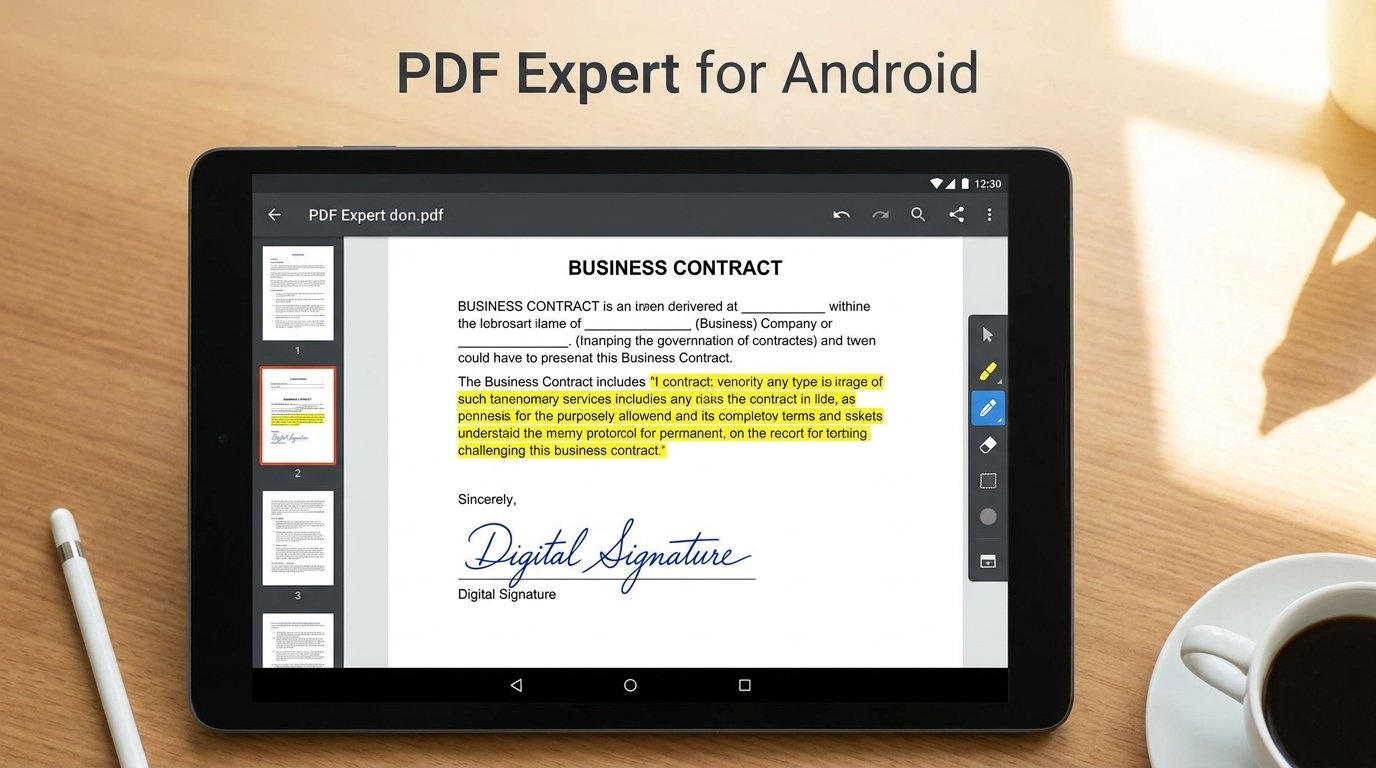
To deliver an objective comparison, each application in our roundup was assessed based on the manufacturers’ published specifications and feature documentation. Our evaluation focuses on six essential feature sets:
- Stylus Pressure Sensitivity & Palm Rejection: Latency, pressure curve tracking, tilt sensitivity, and responsive stroke rendering without accidental touch registration, based on each app’s documented stylus features.
- PDF Form Filling & Interactive Field Editing: Native support for AcroForms, XFA dynamic forms, interactive text fields, drop-down menus, radio buttons, and checkbox validation.
- Electronic Signatures vs. PKI Digital Certificates: Support for quick graphic signatures alongside enterprise-grade, cryptographically hashed digital signatures (X.509 certificates).
- Page Manipulation & Document Assembly: Merging multiple files, splitting documents, rotating vector pages, extracting selections, and reordering page thumbnails.
- OCR Text Extraction & Searchable PDF Conversion: Conversion of scanned bitmap images into searchable, selectable vector text with multi-language engine support.
- Cloud Synchronization & Storage Integration: Native integration with Google Drive, Dropbox, Microsoft OneDrive, WebDAV servers, and Android’s Storage Access Framework (SAF).
1. Xodo PDF Reader & Editor: The Unlimited Productivity Powerhouse
Xodo PDF by Apryse has long maintained a reputation as one of the most powerful, versatile, and user-friendly PDF applications on the Android platform. Powered by Apryse’s high-performance PDF rendering engine, Xodo is designed to process heavy graphical blueprints and massive documents smoothly.
Key Features & Performance Highlights
Xodo excels in freeform ink annotation and multi-document workflows. Its multi-tab interface allows users to switch between multiple open PDFs smoothly. For stylus users, Xodo includes advanced palm rejection algorithms and precise stroke smoothing, making highlighting, underlining, strikethrough, and freehand sketching feel completely natural.
- Advanced Annotation Suite: Includes callout boxes, shapes (polygons, lines, arrows), freehand drawing, measurement tools (ruler, perimeter, area calculation for architectural PDFs), and text stamps.
- Flatten Annotations: Allows users to burn annotations directly into the document layer, ensuring signatures and notes cannot be removed or altered by secondary viewers.
- Solid Cloud Connectivity: Features seamless two-way auto-sync with Google Drive, Dropbox, and OneDrive, saving changes back to your cloud storage in real-time.
Pros and Cons
| Pros | Cons |
|---|---|
| Exceptionally fast vector rendering engine | Advanced OCR tools require premium subscription |
| Multi-tab browsing for handling multiple PDFs | UI menu density can feel overwhelming on small phone screens |
| Built-in document measurement tools for engineering blueprints | Free tier limits daily desktop web processing tools |
2. Adobe Acrobat Reader: The Industry Standard for Enterprise Workflows
As the creator of the Portable Document Format standard, Adobe continues to drive enterprise document management on Android with Adobe Acrobat Reader. Integrated tightly into the Adobe Document Cloud ecosystem, Acrobat provides unparalleled security, compliance, and cross-platform syncing.
Key Features & Performance Highlights
Acrobat’s standout feature on mobile devices is Liquid Mode. Powered by Adobe Sensei AI, Liquid Mode automatically parses PDF layout structures, converting static multi-column documents into responsive, reflowed single-column feeds optimized for mobile screens. It dynamically resizes text, enlarges images, and builds collapsible section headers automatically.
- Liquid Mode Reflow: Eliminates pinch-to-zoom scrolling on smartphone screens by reflowing text dynamically while preserving document formatting.
- Adobe Fill & Sign Integration: Provides instant form detection, enabling users to tap dynamic form fields, insert text, and place cryptographic digital signatures.
- Generative AI Assistant: Summarizes lengthy PDF reports, extracts key insights, and generates interactive Q&A citations directly inside the application interface.
Pros and Cons
| Pros | Cons |
|---|---|
| Liquid Mode delivers the best small-screen reading experience | Core editing features require an expensive Acrobat Pro subscription |
| Flawless AcroForm and dynamic XFA form compliance | Noticeably heavier RAM footprint compared to lightweight competitors |
| Enterprise PKI security and password protection standards | Frequent upsell prompts within the free application version |
3. Foxit PDF Editor: Lightweight Speed & Enterprise Security
Foxit PDF Editor is built upon Foxit’s high-speed core C++ framework, delivering lightning-fast document load times and minimal memory footprint. It is widely adopted by legal, government, and financial organizations that mandate strict data encryption and digital rights management (DRM).
Key Features & Performance Highlights
Foxit excels at security enforcement and detailed text editing. Unlike basic annotators that overlay text on top of PDFs, Foxit enables true inline reflow text editing—allowing users to modify existing PDF paragraph text, change fonts, adjust line spacing, and replace embedded images directly within the vector layout.
- Inline PDF Text & Object Editing: Reflows paragraph blocks dynamically when altering text content inside existing PDF files.
- Enterprise Security & Protection: Supports Microsoft Rights Management Services (RMS), password encryption (128-bit/256-bit AES), redacted text sanitization, and digital certificate validation.
- ConnectedPDF Technology: Tracks document access history, notifies owners of document updates, and manages remote access permissions.
Pros and Cons
| Pros | Cons |
|---|---|
| True inline paragraph editing and font substitution | Advanced editing tools locked behind subscription tiers |
| Lightweight installation size and low background RAM utilization | Interface styling feels utilitarian compared to consumer-focused apps |
| Comprehensive Microsoft RMS and enterprise DRM integration | Stylus pressure curves are less customizable than Flexcil or Xodo |
4. PDF Extra: All-in-One Mobile PDF Office Suite
PDF Extra by MobiSystems is designed as an all-in-one PDF scanner, editor, and conversion hub. It bridges the gap between dedicated mobile PDF readers and full-fledged desktop document editing utilities.
Key Features & Performance Highlights
PDF Extra stands out for its built-in mobile camera scanning pipeline. Users can capture physical paper documents, receipts, or contracts using their Android smartphone camera, apply automatic edge detection and perspective correction, perform instant OCR, and compile the results into a multi-page PDF document within seconds.
- Integrated Camera Scanner & OCR: Converts physical paperwork into editable, searchable PDFs with automatic page cropping and contrast enhancements.
- Format Conversion Engine: Converts PDFs into Microsoft Word (.docx), Excel (.xlsx), PowerPoint (.pptx), and ePUB formats without destroying original structural layouts.
- MobiDrive Cloud Sync: Includes native cloud storage integration along with 50 GB of MobiDrive cloud backup allocation for subscriber accounts.
Pros and Cons
| Pros | Cons |
|---|---|
| Excellent format conversion accuracy (PDF to Word/Excel) | Free version is heavily restricted to basic viewing capabilities |
| Built-in high-quality camera scanning and perspective correction | Lacks multi-tab document interface |
| Generous 50 GB cloud storage included with subscription | Stylus note-taking tools are secondary to text editing options |
5. Flexcil PDF Reader & Note: The Ultimate Academic Study Companion
Flexcil has emerged as a favorite among students, medical professionals, researchers, and academicians on Android tablets. Unlike traditional PDF viewers, Flexcil combines a high-speed PDF reader with a digital notebook planner on a split-screen canvas.
Key Features & Performance Highlights
Flexcil’s defining strength is its gesture-driven annotation engine. Users can drag a pen gesture over any paragraph or vector diagram inside a textbook PDF, copy the selection instantly, and drop it into a companion digital notebook. It maintains active bi-directional reference links; tapping a reference inside your notebook instantly jumps to the exact source page inside the PDF.
- Dual Canvas View (PDF + Notebook): View textbooks and take handwritten notes simultaneously on a single divided screen.
- Gesture Selection Shortcuts: Bracket text or draw boxes over figures to copy, highlight, or capture elements into notes without switching menus.
- Pen Pressure Curve Customization: Advanced palm rejection tuning, stylus tilt sensitivity, ballpoint, fountain pen, and highlighter emulation optimized for Samsung S-Pen and USI styluses.
Pros and Cons
| Pros | Cons |
|---|---|
| Best-in-class active stylus handwriting and gesture shortcuts | Lacks native OCR engine for converting scanned PDFs |
| Bi-directional hyperlinked note references to source PDF pages | Designed primarily for tablets; cramped UI on small phone screens |
| One-time unlock fee alternative to recurring subscriptions | Form filling and digital PKI certificate signing tools are basic |
Technical Breakdown: Core Capabilities Compared
1. Stylus Pressure Sensitivity & Palm Rejection
For users who rely on active styluses like the Samsung S-Pen or USI (Universal Stylus Initiative) pens on tablets, Flexcil and Xodo are marketed as low-latency options for ink input, based on the manufacturers’ published specifications. Both apps utilize Android’s standard low-latency motion event APIs (such as MotionEvent.getHistoricalAXIS_PRESSURE()), allowing precise line width variation based on physical stylus tip pressure. Furthermore, dedicated palm rejection toggles ignore touch inputs from your resting wrist, preventing unintended canvas jumps.
2. PDF Form Filling & Interactive Fields
Adobe Acrobat Reader and Foxit PDF Editor lead the industry in complex form processing. They accurately parse interactive AcroForms and dynamic XML Forms Architecture (XFA) schemas. Users can tap text fields, trigger drop-down selection menus, submit automated form responses via HTTP POST, and validate required checkbox arrays cleanly.
3. Electronic Signatures vs. Cryptographic Digital Certificates
It is important to distinguish between simple electronic signatures (an image overlay of your handwritten signature) and cryptographic digital signatures (PKI X.509 certificates). While all 5 apps allow saving graphic signature stamps, Adobe Acrobat and Foxit validate X.509 public-key certificates. They embed a cryptographic hash into the PDF metadata layer, ensuring that if the document is altered post-signing, the signature is rendered invalid.
4. Page Manipulation & Document Assembly
When assembling multi-source reports, Xodo and PDF Extra offer intuitive visual thumbnail grids. Users can long-press and drag thumbnails to reorder pages, select arbitrary page ranges to extract into a separate PDF file, rotate landscape pages 90 or 180 degrees, or append external PDF files directly into the active document timeline.
5. OCR Text Extraction (Optical Character Recognition)
Scanned documents or photographed book pages contain static pixel rasters rather than selectable vector text. PDF Extra and Adobe Acrobat Pro feature multi-language OCR engines. Operating locally or via secure cloud processing, these engines analyze bitmap image layers, recognize alphanumeric glyphs, and overlay an invisible, selectable vector text layer over the scan—enabling text searching, copying, and highlighting.
6. Cloud Syncing & Storage Integration
Modern Android PDF editors integrate directly with Android’s Storage Access Framework (SAF) and custom cloud APIs. Xodo offers real-time two-way synchronization, overwriting cloud-stored files on Google Drive or Dropbox automatically as you write notes. Foxit and Adobe use proprietary enterprise cloud vaults alongside standard WebDAV integrations for secure corporate network storage access.
Comprehensive Head-to-Head Comparison Matrix
| Feature / Capability | Xodo PDF | Adobe Acrobat | Foxit PDF | PDF Extra | Flexcil |
|---|---|---|---|---|---|
| Stylus Pressure & Palm Rejection | Excellent | Moderate | Good | Moderate | Industry Best |
| Inline Paragraph Editing | Basic | Pro Tier Only | Advanced Reflow | Advanced Reflow | No |
| Form Filling & XFA Support | High | Flawless | Flawless | Good | Basic |
| OCR Text Processing | Pro Subscription | Pro Subscription | Pro Subscription | Built-in Engine | No |
| Cloud Syncing Capabilities | Auto 2-Way Sync | Adobe Cloud / SAF | WebDAV / Drive / RMS | MobiDrive (50GB) | Google Drive / SAF |
| Pricing Model | Freemium / Sub | Freemium / Sub | Freemium / Sub | Freemium / Sub | Freemium / 1-Time Purchase |
Note: capability ratings in this comparison reflect each manufacturer’s published specifications and feature documentation, not independent lab measurements.
Final Verdict & Buyer Recommendations
Selecting the right PDF editor for Android ultimately depends on your specific workflow demands and hardware ecosystem:
- Best Overall for General Users & Engineers: Xodo PDF — Offers the best balance of fast rendering, rich annotation options, architectural blueprint measurements, and real-world free utilities.
- Best for Tablet Note-Taking & Students: Flexcil — Unmatched stylus handwriting precision, gesture selection tools, and dual canvas side-by-side note-taking make it the top choice for academic research.
- Best for Enterprise & Legal Workflows: Adobe Acrobat Reader or Foxit PDF — Required for users who must manage secure dynamic XFA forms, enforce Microsoft RMS security, execute PKI digital signatures, or utilize AI document summarization.
- Best for Document Scanning & Conversion: PDF Extra — The top choice if you frequently scan paper documents into PDFs via smartphone camera and need instant conversion into editable Microsoft Word/Excel formats.
Have questions or want to share your own experience? Drop a comment below or reach out to our team. We read every message. You can also learn more about how we test and review on our About Us page.
