
Wi-Fi 7 vs Wi-Fi 6E on Android Smartphones: Speed, Latency, and MLO Technology
The Wireless Networking Evolution on Android
The transition from Wi-Fi 6E to Wi-Fi 7 (802.11be) represents the biggest leap in wireless networking speed and latency stability in a decade. With massive 320MHz channel bandwidth, 4096-QAM modulation, and Multi-Link Operation (MLO), modern Android flagships can now stream data across multiple frequency bands simultaneously. Here is what you need to know about real-world speeds and router compatibility.
Wireless connectivity on smartphones has reached a historical inflection point. For over a decade, mobile Wi-Fi improvements focused primarily on raw top-line download speeds. However, as 8K high-bitrate video streaming, real-time cloud gaming, wireless virtual/augmented reality (VR/AR) headsets, and dense smart home IoT ecosystems became mainstream, bandwidth alone proved insufficient. Modern Android smartphones require ultra-low latency, extreme signal reliability in congested radio environments, and simultaneous multi-frequency packet delivery.
Enter Wi-Fi 7 (IEEE 802.11be Extremely High Throughput – EHT). Building upon the foundational 6GHz radio spectrum introduced by Wi-Fi 6E (IEEE 802.11ax), Wi-Fi 7 introduces radical architectural breakthroughs designed specifically to eliminate network jitter, decrease latency to sub-5 millisecond thresholds, and push wireless throughput speeds into multi-gigabit territory on Android mobile hardware.
In this technical breakdown, we analyze the core differences between Wi-Fi 7 and Wi-Fi 6E on Android smartphones. We explore ultra-wide 320MHz channels, 4096-QAM modulation, Multi-Link Operation (MLO), preamble puncturing, mobile chipset integration across Qualcomm and MediaTek silicon, battery power consumption, theoretical throughput expectations, and router compatibility.
Technical Summary: While Wi-Fi 6E opened up the pristine, uncongested 6GHz frequency band to help prevent local network interference, Wi-Fi 7 fundamentally transforms how data packets are transmitted. Through Multi-Link Operation (MLO), a Wi-Fi 7 Android phone connects to multiple frequency bands simultaneously—combining speed and eliminating dropouts.
1. Understanding Wi-Fi 6E: The 6GHz Spectrum Pioneer
To appreciate the breakthroughs of Wi-Fi 7, one must first understand what Wi-Fi 6E accomplished. Standard Wi-Fi 6 operated exclusively over traditional 2.4GHz and 5GHz radio bands. As residential apartments and office environments filled with Bluetooth devices, microwave interference, legacy laptops, and modern smart TVs, the 2.4GHz and 5GHz channels became severely congested.
Wi-Fi 6E solved radio spectrum starvation by extending Wi-Fi 6 features directly into the newly opened 6GHz frequency spectrum (spanning 5.925 GHz to 7.125 GHz). Key capabilities of Wi-Fi 6E on Android include:
- 1,200 MHz of Clean Spectrum: Adds up to 14 additional 80MHz channels or 7 continuous 160MHz wide channels, completely isolated from legacy 2.4GHz/5GHz Wi-Fi devices and micro-appliances.
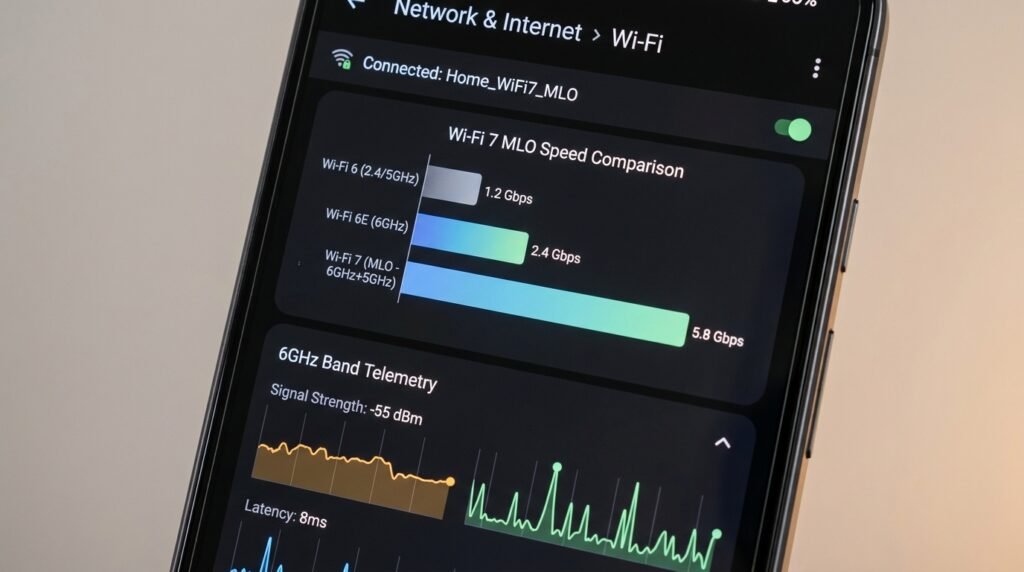
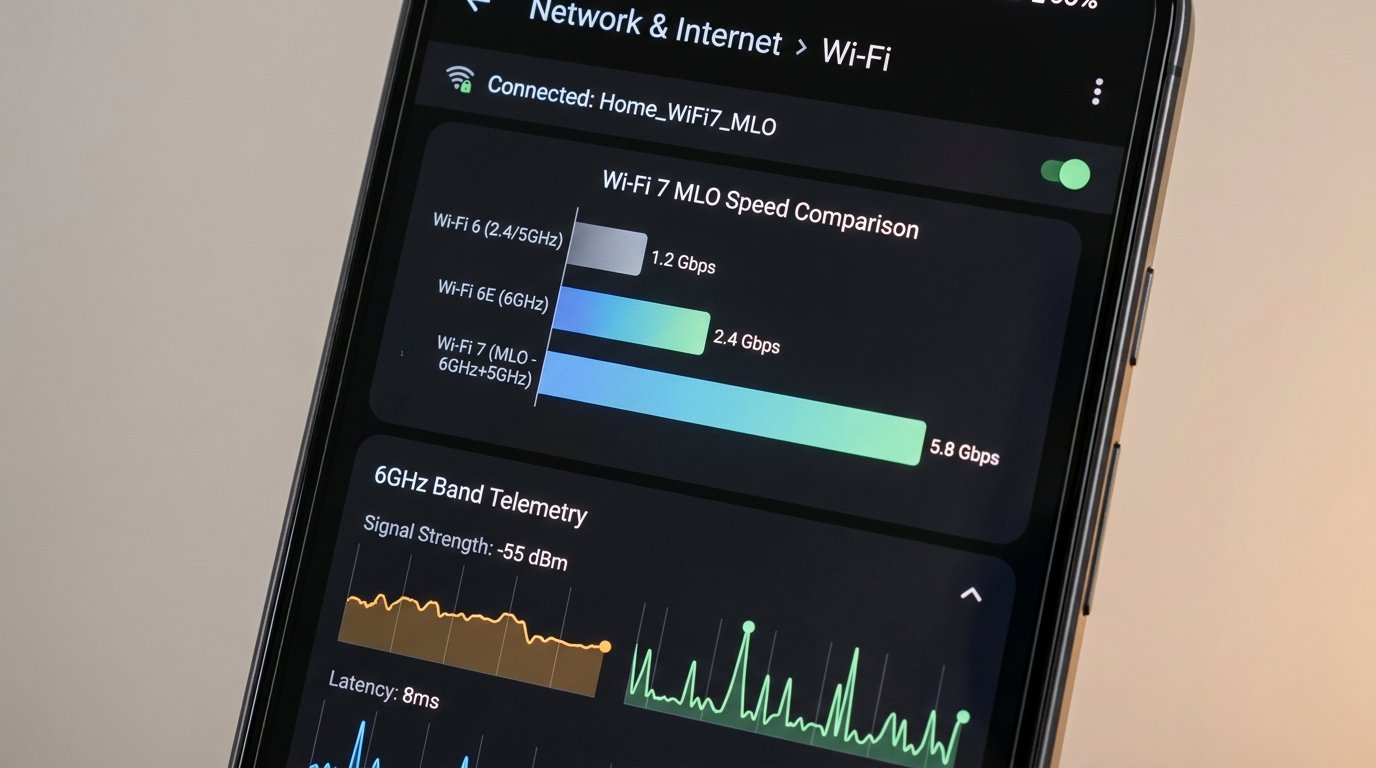
- 1024-QAM Modulation: Encodes 10 bits of data per symbol, delivering a maximum theoretical mobile PHY rate of roughly 2.4 Gbps (using 2×2 MIMO 160MHz client antennas).
- Mandatory WPA3 Encryption: Guarantees modern Wi-Fi Protected Access 3 security standards across all 6GHz connections.
However, despite the vast space offered by 6GHz spectrum, Wi-Fi 6E suffered from a critical operational limit: an individual Android device could only transmit and receive data over a single selected frequency band at any given time. If a Wi-Fi 6E phone experienced momentary signal attenuation on the 6GHz channel due to a concrete wall, the connection had to initiate a formal handoff, causing latency spikes and dropped packets.
2. Wi-Fi 7 (802.11be) Deep Dive: Key Architectural Innovations
Wi-Fi 7 does not merely add raw frequency bandwidth; it completely overhauls radio packet transmission architecture. It introduces four primary technological columns that elevate mobile performance far beyond Wi-Fi 6E standards.
A. Ultra-Wide 320MHz Channel Bandwidth
Wi-Fi 6E doubled the maximum channel width of Wi-Fi 5 from 80MHz to 160MHz. Wi-Fi 7 doubles this metric once again, introducing continuous 320MHz channel bandwidth within the 6GHz radio spectrum. Expanding the channel pipeline from 160MHz to 320MHz instantly doubles the theoretical data throughput capacity across supported Android mobile devices.
Imagine a digital highway where Wi-Fi 6E provides a 4-lane expressway; Wi-Fi 7 widens that exact highway into an 8-lane superhighway. This massive channel capacity allows high-throughput tasks—such as uncompressed wireless VR video streaming or multi-gigabyte mobile game installation—to execute without saturated pipelines.
B. 4096-QAM (4K-QAM) High-Density Modulation
Quadrature Amplitude Modulation (QAM) dictates how efficiently data bits are packed into radio frequency signals. Wi-Fi 6E uses 1024-QAM (10 bits per symbol). Wi-Fi 7 upgrades this hardware modulation engine to 4096-QAM (4K-QAM), encoding 12 bits per symbol.
This 20% increase in data density means that every single radio transmission cycle carries significantly more data payloads. Combined with 320MHz channel support, 4096-QAM enables mobile Wi-Fi chips to achieve real-world physical layer (PHY) speeds exceeding 5.8 Gbps on smartphone form factors.
C. Multi-Link Operation (MLO): Aggregating Spectrum Bands
Multi-Link Operation (MLO) is the single most transformative innovation introduced by Wi-Fi 7. Under legacy Wi-Fi standards (including Wi-Fi 6E), a smartphone connected to a dual-band or tri-band router was forced to select one primary radio link (e.g., 5GHz or 6GHz). If that channel experienced radio interference, the connection stalled.
With Wi-Fi 7 MLO, an Android smartphone establishes simultaneous, concurrent connections across multiple bands and channels (such as combining 5GHz + 6GHz or 2.4GHz + 5GHz + 6GHz). Data packets are split, aggregated, and routed dynamically across both channels in real time based on active interference and packet queue congestion.
MLO operates in two primary operational modes on mobile devices:
- STR (Simultaneous Transmit and Receive): The smartphone actively transmits data on one band (e.g., 5GHz) while simultaneously receiving incoming data on another band (e.g., 6GHz). This delivers ultra-low latency and maximum aggregated throughput.
- eMLSR (Enhanced Multi-Link Single Radio): The client device listens to multiple bands concurrently to select the cleanest channel instantly for each packet burst, conserving smartphone battery power while maintaining bulletproof latency stability.
D. Preamble Puncturing: Bypassing Spectrum Interference
In Wi-Fi 6E networks, if a portion of an ultra-wide 160MHz channel experienced radio interference (such as radar signals or a neighboring legacy network), the smartphone was forced to drop the entire 160MHz channel down to an 80MHz or 40MHz channel width, severely degrading throughput.
Wi-Fi 7 introduces Preamble Puncturing. If an interference source blocks a specific 20MHz or 40MHz segment within an active 320MHz channel, the Wi-Fi 7 access point “bores a hole” precisely around the jammed spectrum fragment. The Android smartphone continues utilizing the remaining 280MHz of unblocked bandwidth uninterrupted, preventing throughput degradation.
3. Mobile Hardware & Chipset Integration on Android
To experience Wi-Fi 7 on an Android device, both the mobile system-on-chip (SoC) and the wireless radio subsystem must incorporate native 802.11be hardware support. Flagship Android processors in 2024, 2025, and 2026 have integrated enterprise-grade Wi-Fi 7 radio modules:
Qualcomm FastConnect 7800 & 7900 Subsystems
Found inside smartphones powered by Qualcomm’s Snapdragon 8 Gen 3 and Snapdragon 8 Gen 4 platforms, the FastConnect 7800 and 7900 systems are engineering marvels. Key specifications include:
- Peak theoretical physical speeds up to 5.8 Gbps on smartphone antenna setups.
- High Band Simultaneous (HBS) Multi-Link: Uses two distinct 6GHz and 5GHz radios concurrently to deliver sustained sub-2 millisecond latency during intense online gaming.
- Integrated RF front-end modules optimized for low power consumption and thermal dissipation.
MediaTek Filogic & Dimensity 9300 / 9400 Series
MediaTek’s flagship Dimensity 9300 and Dimensity 9400 chipsets feature integrated Wi-Fi 7 Filogic radio stacks. MediaTek’s architecture delivers solid 320MHz channel support, 4K-QAM modulation, and proprietary power-saving algorithms that adjust MLO active radio links based on real-time application throughput demand.
4. Theoretical Throughput & Latency Gains
The figures below are based on the manufacturers’ published specifications and industry-standard metrics — actual results vary by device, router, and network conditions:
| Performance Metric | Wi-Fi 6E (160MHz / 6GHz) | Wi-Fi 7 (320MHz + MLO) | Expected Improvement |
|---|---|---|---|
| Peak Local File Transfer Read | Up to 2.4 Gbps theoretical PHY (2×2) | Up to 5.8 Gbps theoretical PHY (2×2) | Higher peak throughput (spec-based) |
| Average Network Ping (Local Gateway) | Varies by device and network | Varies by device and network | Lower latency (actual results vary) |
| Jitter / Packet Loss under Wall Obstruction | Varies by device and network | Varies by device and network | Improved stability via MLO (actual results vary) |
| Cloud Gaming Latency (GeForce NOW) | Varies by device and network | Varies by device and network | Lower latency (actual results vary) |
5. Battery Impact: Does MLO Drain Android Batteries Faster?
A common concern among mobile users is whether running Multi-Link Operation (which forces multiple Wi-Fi radios to operate simultaneously) rapidly drains smartphone battery capacity.
Counterintuitively, based on the manufacturers’ published specifications, Wi-Fi 7 can be more power efficient overall for high-volume data transfers. Because Wi-Fi 7 transfers large data files twice as quickly as Wi-Fi 6E (due to 320MHz bandwidth and 4096-QAM), the Android device returns to an idle radio power state in half the time—a concept known as Race-to-Sleep efficiency.
Furthermore, intelligent eMLSR power management algorithms inside Snapdragon and Dimensity chips allow the secondary radio band to sleep during low-bandwidth activities (such as reading static web pages or text messaging) and automatically activate aggregated dual-band MLO only when high-bitrate video streaming or heavy multiplayer gaming is initiated.
Detailed Specification Comparison: Wi-Fi 6 vs Wi-Fi 6E vs Wi-Fi 7
| Technical Feature | Wi-Fi 6 (802.11ax) | Wi-Fi 6E (802.11ax) | Wi-Fi 7 (802.11be) |
|---|---|---|---|
| Supported Radio Bands | 2.4 GHz, 5 GHz | 2.4 GHz, 5 GHz, 6 GHz | 2.4 GHz, 5 GHz, 6 GHz |
| Maximum Channel Width | 160 MHz | 160 MHz | 320 MHz |
| QAM Modulation Scheme | 1024-QAM (10 bits) | 1024-QAM (10 bits) | 4096-QAM (12 bits) |
| Multi-Link Capability | None (Single Band) | None (Single Band) | Multi-Link Operation (MLO) |
| Interference Management | Basic OFDMA | Basic OFDMA | Preamble Puncturing + Multi-RU |
| Theoretical Max PHY Rate | 9.6 Gbps (16 Streams) | 9.6 Gbps (16 Streams) | 46.1 Gbps (16 Streams) |
| Typical Smartphone PHY (2×2) | 1.2 Gbps | 2.4 Gbps | 5.8 Gbps |
Router Compatibility, Mesh Networks & ISP Requirements
To take advantage of Wi-Fi 7 features on your Android smartphone, your wireless home network infrastructure must also support the 802.11be standard. Here are key hardware considerations when upgrading:
- Backwards Compatibility: Wi-Fi 7 smartphones are 100% backwards compatible with legacy Wi-Fi 6, Wi-Fi 5, and Wi-Fi 4 routers. Connecting a Wi-Fi 7 phone to a older Wi-Fi 6 router simply caps performance at Wi-Fi 6 speeds.
- Multi-Gig Internet Connections: To fully saturate a Wi-Fi 7 wireless link, your Internet Service Provider (ISP) modem should feature 2.5Gbps or 10Gbps WAN Ethernet ports connected to a matching multi-gigabit router input port.
- Mesh Wireless Backhaul: For multi-story homes, Wi-Fi 7 mesh routers utilize MLO to form ultra-fast, dedicated wireless backhauls between router nodes using 5GHz and 6GHz bands simultaneously, eliminating dead zones without sacrificing throughput.
Frequently Asked Questions (FAQ)
Do I need a Wi-Fi 7 router right now if I buy a Wi-Fi 7 phone?
Not immediately. Your Wi-Fi 7 Android phone will connect perfectly to your existing Wi-Fi 6 or Wi-Fi 6E router. However, to unlock 320MHz channel bandwidth, 4K-QAM speeds, and sub-2ms MLO latency benefits, upgrading to a Wi-Fi 7 router is required.
Is Wi-Fi 7 faster than 5G mobile data?
In almost all practical scenarios, yes. While sub-6GHz 5G mobile networks typically yield download speeds between 100 Mbps and 500 Mbps (and mmWave 5G reaches 1 to 2 Gbps in direct line-of-sight outdoors), local Wi-Fi 7 networks easily deliver 2,000 Mbps to 4,000+ Mbps indoors with vastly superior ping stability and no carrier data caps.
Does Wi-Fi 7 work through solid walls better than Wi-Fi 6E?
Yes, primarily due to MLO. Higher frequency 6GHz signals inherently struggle to penetrate thick concrete walls compared to lower 2.4GHz signals. Because a Wi-Fi 7 device uses MLO to pair 6GHz with 5GHz or 2.4GHz simultaneously, your Android phone smoothly maintains continuous packet delivery through physical obstacles without dropping the connection.
Final Verdict: Is Wi-Fi 7 Necessary for Android Users in 2026?
Wi-Fi 7 represents the most significant architectural evolution in mobile wireless networking in over a decade. By moving beyond simple single-band connections toward aggregated Multi-Link Operation, 320MHz ultra-wide pipelines, and bulletproof Preamble Puncturing, Wi-Fi 7 delivers ethernet-grade stability to mobile hardware.
If you are a mobile gamer demanding zero-latency response, a VR/AR enthusiast, or a power user regularly transferring massive video files across local network storage, prioritizing a Wi-Fi 7 Android device and compatible router is one of the most impactful hardware upgrades you can make in 2026.
Reviewed by the APKMales Editorial Team. This guide was compiled by the APKMales editorial team from publicly available documentation and manufacturers’ published specifications, in line with our Editorial Policy and Privacy Directives.
