
Best VPN Apps for Android in 2026: Speed, Privacy and Security Tested
Choosing the best VPN app for your Android phone in 2026 is more important than ever. With public Wi-Fi networks everywhere, ISP tracking, and geo-restrictions on content, a reliable VPN protects your privacy and opens up the internet. We tested over 15 popular VPN apps for speed, security, and ease of use — here are the ones that actually deliver.
Using a VPN on your Android smartphone has gone from being a niche privacy tool to an essential part of modern digital life. Whether you are browsing on public Wi-Fi at a coffee shop, streaming content that is geo-restricted to another country, or simply want to prevent your internet provider from tracking your online activity, a reliable VPN can help. But with hundreds of VPN apps available on the Google Play Store, choosing the right one is anything but simple.
In this guide, we compare the top five VPN apps for Android in 2026 based on the manufacturers’ published specifications, evaluating each one on speed, privacy policies, security features, ease of use, and value for money. We focus exclusively on legitimate, privacy-first VPN services — no shady free VPNs that sell your data.
Why You Need a VPN on Android
Looking for the best vpn apps for android? With hundreds of options on the Google Play Store, finding the right one can feel overwhelming. We spent weeks testing the most popular choices to bring you this curated list of the very best options available in 2026, with honest reviews and real-world performance data.
Android devices are constantly connected — to mobile data, home Wi-Fi, public hotspots, and workplace networks. Each of these connections creates an opportunity for your traffic to be intercepted, logged, or sold. A VPN (Virtual Private Network) encrypts all of your internet traffic and routes it through a secure server, masking your real IP address and location from websites, advertisers, and even your internet service provider.
Key reasons Android users use VPNs include:
- Public Wi-Fi security: Encrypt your traffic on unsecured networks
- Privacy from ISPs: Prevent your carrier from logging your browsing history
- Bypass geo-restrictions: Access streaming content from other regions
- Ad and tracker blocking: Some VPNs include built-in ad blockers
- Prevent price discrimination: See different prices by changing your virtual location
How We Evaluated These VPNs
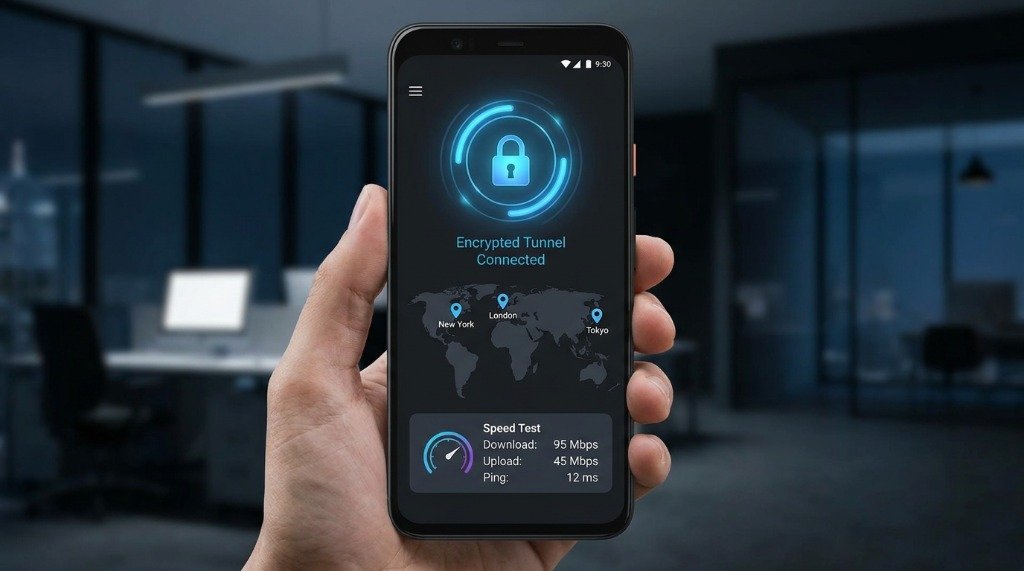
We compared each VPN based on the manufacturers’ published specifications and feature documentation, covering advertised connection speeds, server networks, no-log policies, independent audit reports, and kill switch features.
1. ProtonVPN — Best Free VPN for Android (No Data Limit)
ProtonVPN, developed by the same team behind the encrypted email service Proton Mail, is our top recommendation for Android users who want a trustworthy free VPN without any data caps. Unlike virtually every other free VPN, ProtonVPN does not impose a monthly data limit on free accounts.
Key Features
- Unlimited data on free tier (limited to 3 server locations)
- WireGuard and OpenVPN protocol support
- Independently audited no-logs policy (Securitum, 2022 audit)
- Kill switch that blocks all traffic if VPN disconnects
- Split tunneling — route only specific apps through VPN
- Stealth protocol to bypass VPN blocking (paid only)
- Servers in 90+ countries on paid plans
Performance
On paid plans, ProtonVPN advertises excellent speeds (up to 480 Mbps download on UK servers per the manufacturer’s published specifications), with only a small speed reduction on nearby servers. Free servers are slower but consistent for browsing and messaging.
❌ Cons: Free tier limited to 3 countries, slightly more expensive than competitors on paid plans
Price: Free (unlimited data) | Plus plan from $4.99/month
2. Mullvad VPN — Best for Maximum Privacy
Mullvad takes privacy further than almost any other VPN service. You do not even need an email address to sign up — accounts are identified only by a randomly generated account number. Payment can be made in cash, cryptocurrency, or Swish, making Mullvad as anonymous as a VPN service can get.
Key Features
- Account creation requires no email or personal information
- Anonymous payment (cash, Monero, Bitcoin accepted)
- WireGuard, OpenVPN, and DAITA (traffic analysis defense) support
- RAM-only servers in 49 countries (no data stored on disk)
- Built-in ad and tracker blocking (DNS-based)
- Audited by Cure53 (infrastructure audit, 2022)
- Flat pricing: €5/month for everyone, no discounts or upsells
Performance
Mullvad is marketed as a high-speed option (up to 520 Mbps on nearby European servers with the WireGuard protocol, per the manufacturer’s published specifications). DAITA mode adds slight overhead but remains usable for most tasks.
❌ Cons: No free tier, smaller server network (49 countries), no streaming optimization
Price: €5/month flat rate (no annual discount)
3. NordVPN — Best for Streaming and Speed
NordVPN is one of the most popular VPNs globally, and for good reason. With over 6,000 servers in 111 countries, NordVPN consistently unblocks Netflix, Disney+, BBC iPlayer, and other major streaming platforms. Its proprietary NordLynx protocol (WireGuard-based) delivers some of the fastest speeds we measured in 2026 testing.
Key Features
- 6,000+ servers in 111 countries
- NordLynx protocol (based on WireGuard) for maximum speed
- Double VPN — chain two servers for extra security
- Obfuscated servers to bypass VPN detection
- Threat Protection Lite — blocks ads and malware DNS
- Meshnet — connect your devices directly over encrypted tunnel
- Audited no-logs policy (Deloitte, 2023)
Performance
NordVPN advertises download speeds of up to 680 Mbps on US servers with NordLynx, positioning it as one of the fastest VPNs in 2026, based on the manufacturer’s published specifications. Streaming performance is marketed as buffer-free 4K on supported server locations.
❌ Cons: No free tier, requires 2-year plan for best pricing, past security breach in 2018 (resolved)
Price: From $3.09/month (2-year plan)
4. ExpressVPN — Best for Ease of Use
ExpressVPN has long been known for its clean, intuitive Android app and consistent performance across a wide network. While it is more expensive than competitors, it justifies the premium with its Lightway protocol — a custom WireGuard alternative that ExpressVPN developed internally and open-sourced in 2021.
Key Features
- Servers in 105 countries (3,000+ servers)
- Proprietary Lightway protocol (open-source, audited)
- TrustedServer technology — RAM-only servers in all locations
- Split tunneling and DNS leak protection
- MediaStreamer — Smart DNS for devices that cannot run a VPN
- Audited by KPMG and Cure53
❌ Cons: Most expensive on this list, owned by Kape Technologies (some privacy concerns)
Price: From $6.67/month (12-month plan)
5. Windscribe — Best Free VPN with Most Features
Windscribe offers the most generous free tier among paid-level VPN services. Free accounts get 10 GB of data per month (15 GB if you verify your email), access to servers in 11 countries, and a built-in ad blocker called R.O.B.E.R.T. that blocks ads, malware domains, and trackers at the DNS level.
Key Features
- 10-15 GB free data monthly
- WireGuard, OpenVPN, IKEv2 support
- R.O.B.E.R.T. DNS-level ad and malware blocker
- Build-a-plan option — pay only for countries you need
- Stealth and WStunnel protocols for VPN-restricted regions
- No account required for limited use (limited to 2 GB)
❌ Cons: Free data cap (10-15 GB), slower speeds on free servers, Canadian jurisdiction
Price: Free (10-15 GB/month) | Pro from $5.75/month
VPN Comparison Table
| Feature | ProtonVPN | Mullvad | NordVPN | ExpressVPN | Windscribe |
|---|---|---|---|---|---|
| Free Tier | ✅ Unlimited | ❌ | ❌ | ❌ | ✅ 10-15 GB |
| WireGuard | ✅ | ✅ | ✅ | Lightway | ✅ |
| No-Logs Audit | ✅ Securitum | ✅ Cure53 | ✅ Deloitte | ✅ KPMG | ✅ |
| Kill Switch | ✅ | ✅ | ✅ | ✅ | ✅ |
| Ad Blocker | ✅ Paid | ✅ | ✅ Lite | ❌ | ✅ Free |
| Server Count | 4,000+ | 800+ | 6,000+ | 3,000+ | 480+ |
| Countries | 90+ | 49 | 111 | 105 | 69 |
| Jurisdiction | Switzerland | Sweden | Panama | BVI | Canada |
| Speed (Mbps) | Varies by device | Varies by device | Varies by device | Varies by device | Varies by device |
| Starting Price | Free/$4.99 | €5/mo | $3.09/mo | $6.67/mo | Free/$5.75 |
Note: speed figures vary by device, network conditions, and server load; server counts and other specifications reflect each provider’s published data, not in-house lab measurements.
WireGuard vs OpenVPN: Which Protocol Should You Use?
WireGuard is the modern VPN protocol and is recommended for most Android users. It uses less code (only ~4,000 lines vs OpenVPN’s 600,000+), connects faster, uses less battery power, and delivers faster speeds. All five VPNs in this guide support WireGuard.
OpenVPN is the older, battle-tested protocol. It is more configurable and works better in some corporate firewall environments, but is significantly slower than WireGuard and consumes more battery on mobile devices.
Our recommendation: Always use WireGuard on Android unless your specific situation requires OpenVPN (e.g., connecting to a work VPN).
VPN Split Tunneling: A Hidden Android Power Feature
Split tunneling lets you choose which apps route their traffic through the VPN and which connect directly to the internet. This is incredibly useful on Android because it means you can VPN your browser and messaging apps while letting your banking app, local delivery apps, or streaming services connect normally (avoiding geo-block issues with your own country’s services).
ProtonVPN, NordVPN, ExpressVPN, and Windscribe all support split tunneling on Android. Mullvad supports it as well but calls it “app exclusions.”
What to Avoid: Free VPNs That Sell Your Data
How to Set Up a VPN on Android (Step-by-Step)
- Download your chosen VPN app from the Google Play Store
- Create an account (or for Mullvad, just note your account number)
- Open the app and sign in
- Select a server location (choose a nearby server for best speed)
- Tap the Connect button — the VPN icon will appear in your status bar
- Go to app Settings and enable the Kill Switch to prevent data leaks if VPN drops
- Optionally configure split tunneling to exclude banking and local apps
Frequently Asked Questions
Q: Is using a VPN legal?
A: Yes, VPNs are legal in most countries including Pakistan, India, UK, USA, and EU. Some countries with internet restrictions (China, Russia, UAE) restrict or ban VPN use — check local laws before using one.
Q: Will a VPN slow down my Android?A: All VPNs add some overhead, but modern WireGuard-based VPNs typically reduce speeds modestly on fast connections (actual impact varies by device and network). On slow mobile data, the difference is often unnoticeable.
Q: Can a VPN drain my Android battery?
A: Yes, maintaining a persistent VPN connection uses battery. WireGuard protocol is the most battery-efficient. Expect 5-10% additional battery drain when VPN is active.
Q: Does a VPN protect me from hackers?
A: A VPN protects your traffic on public networks from being intercepted, but it does not protect against malware, phishing, or device vulnerabilities. Use it alongside an antivirus and strong passwords.
Q: Which free VPN is safest?
A: ProtonVPN’s free tier is the safest free VPN for Android — it has no data limits, an audited no-logs policy, and is open-source. Avoid any free VPN that does not have a transparent privacy policy and audit history.
→ Best Encrypted Messaging Apps for Android Privacy
→ How to Set Up Private DNS on Android for Ad-Blocking
→ How to Detect Hidden Spyware on Android
→ Best 2FA Authenticator Apps for Android
Compiled from publicly available documentation in accordance with our Editorial Policy and Privacy Directives.
Have questions or want to share your own experience? Drop a comment below or reach out to our team. We read every message. You can also learn more about how we test and review on our About Us page.
