
Fast Charging Technologies Explained: USB-PD, PPS, GaN, and Smartphone Battery Longevity
Introduction: The Fast Charging Revolution in 2026
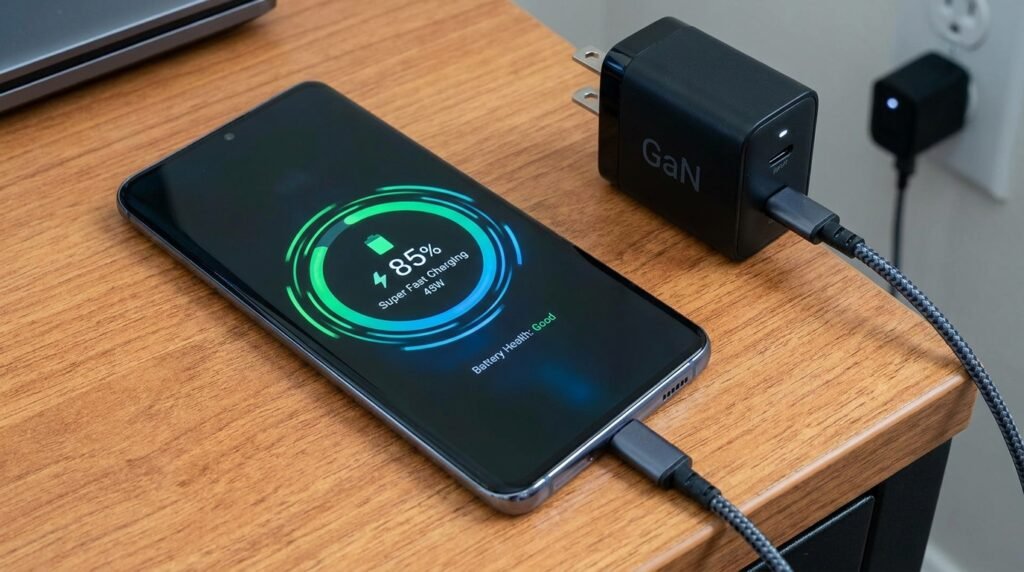
From USB Power Delivery 3.1 and Programmable Power Supply (PPS) to modern Gallium Nitride (GaN) wall chargers, fast charging technology has evolved rapidly. In this hardware guide, we explain how fast charging protocols communicate with smartphone power management chips while debunking myths about battery lifespan degradation.
Mobile device charging speeds have experienced exponential growth over the past decade. Where smartphone users once waited two to three hours to replenish a modest 3,000 mAh battery using standard 5W or 10W wall bricks, today’s flagship and mid-range devices frequently boast charging speeds ranging from 45W and 65W up to a mind-boggling 240W. With these extreme power transfers, a smartphone battery can top off from flat zero to 100% capacity in under 15 minutes.
However, extreme power delivery brings complex engineering challenges. Delivering tens of amperes into a compact smartphone enclosure generates significant thermal energy, which can accelerate chemical degradation inside lithium-ion battery cells. Understanding the underlying technologies—such as USB Power Delivery (USB-PD), Programmable Power Supply (PPS), Gallium Nitride (GaN) semiconductors, and dual-cell battery architectures—is essential for any tech enthusiast who wants fast charging without sacrificing long-term device longevity.
In this comprehensive deep dive, we will break down how modern fast-charging protocols work, examine the physical mechanics of battery degradation, evaluate GaN charger efficiency, and provide actionable tips to keep your smartphone battery healthy for years.
The Electrochemistry of Smartphone Batteries: Why Fast Charging Generates Heat
To understand fast charging, we must first examine the chemical structure of modern smartphone batteries. Almost all contemporary smartphones utilize Lithium-Ion (Li-ion) or Lithium-Polymer (Li-Po) rechargeable batteries. These cells consist of a graphite anode (negative electrode), a lithium transition metal oxide cathode (positive electrode), a porous separator, and a liquid or gel electrolyte that facilitates lithium ion movement.
The Two-Phase Charging Cycle: Constant Current vs. Constant Voltage
Charging a lithium-ion battery is not a uniform process. Microcontrollers regulate power delivery through two distinct operational phases:
- Constant Current (CC) Phase: When your battery is between 0% and 70-80% capacity, the charger supplies a high, continuous current while the voltage gradually rises to its peak threshold (typically 4.2V to 4.45V per cell). This is the phase where fast charging occurs and maximum energy is deposited into the battery.
- Constant Voltage (CV) Phase: Once the cell reaches its maximum rated voltage, the charger switches to maintaining a constant voltage while progressively tapering down the electric current. As the cell nears 100% state of charge, the current decreases to near zero to prevent overcharging and lithium plating.
Key Engineering Insight: Heat generation during fast charging is governed by Joule heating (P = I²R). Because power dissipation increases with the square of the current, sending high current directly into a battery creates significant thermal buildup inside the phone unless voltage and current are precisely and dynamically adjusted.
Demystifying USB Power Delivery (USB-PD) and USB-PD 3.1 Extended Power Range
USB Power Delivery (USB-PD) is the universal open standard governed by the USB Implementers Forum (USB-IF). Designed to work exclusively over USB Type-C connections, USB-PD allows devices to negotiate power levels up to 240W across standardized voltage profiles.
Standard Power Range (SPR) vs. Extended Power Range (EPR)
Under the initial USB-PD 2.0 and 3.0 specifications, known as Standard Power Range (SPR), maximum power delivery was capped at 100W (20V at 5A). However, with the ratification of USB-PD 3.1, the USB-IF introduced Extended Power Range (EPR), increasing peak power transfer capability up to 240W (48V at 5A).
USB-PD operates through a bidirectional digital negotiation over the Configuration Channel (CC) pins inside the USB-C cable. When a phone is plugged into a USB-PD charger, the charger advertises its capabilities (Fixed Power Data Objects or PDOs), and the phone’s Power Management Integrated Circuit (PMIC) selects the optimal voltage and current profile.
Programmable Power Supply (PPS): The Secret to Cool Fast Charging
While standard USB-PD offers fixed step voltages (such as 5V, 9V, 15V, and 20V), step-down voltage conversion inside the smartphone generates unwanted thermal energy. This is where Programmable Power Supply (PPS) plays a crucial role.
How PPS Dynamically Adjusts Voltage and Current
PPS is an optional extension of the USB-PD 3.0/3.1 specification. Instead of locking the charger into fixed voltage outputs, PPS allows the smartphone’s battery controller to request minute adjustments in output voltage in tiny 20mV (0.02V) increments and current in 50mA increments.
By matching the output voltage of the wall charger directly to the real-time electrochemical requirement of the battery cell, PPS eliminates the need for aggressive buck-converter voltage reduction inside the phone body. Shifting the thermal loss away from the smartphone handset directly to the wall adapter keeps the phone significantly cooler during aggressive 25W, 45W, or 65W charging cycles.
Gallium Nitride (GaN) Semiconductors: Small Chargers, High Watts
Historically, power adapters used silicon-based transistors for high-voltage switching. However, silicon’s physical limitations cap thermal efficiency and require large transformers and heat sinks. The industry transition to Gallium Nitride (GaN) semiconductors has completely revolutionized charger design.
Why GaN Superiority Matters for Mobile Power
GaN is a wide-bandgap (WBG) semiconductor material with superior electrical and thermal characteristics compared to traditional silicon:
- Higher Bandgap Energy: GaN has a bandgap of 3.4 eV compared to Silicon’s 1.1 eV, allowing it to withstand higher electric fields without breakdown.
- Faster Switching Speeds: GaN transistors can switch on and off at frequencies up to 10 times faster than silicon switches. Faster switching allows internal inductors and capacitors to shrink drastically.
- Lower Resistance & Heat: GaN features lower on-resistance (R_DS(on)), resulting in significantly reduced power dissipation as waste heat.
Proprietary Charging Standards vs. Universal USB-PD
While USB-PD and PPS provide universal fast charging for Samsung, Google, Apple, and laptop manufacturers, Chinese smartphone brands (such as Xiaomi, OPPO, OnePlus, and Vivo) often employ proprietary high-speed charging ecosystems.
Dual-Cell Batteries and Charge Pumps
Technologies such as OnePlus SuperVOOC and Xiaomi HyperCharge achieve speeds up to 120W–240W using proprietary charger-and-cable handshakes. They accomplish this through two engineering breakthroughs:
- Dual-Cell Battery Configurations: Instead of charging one single 5,000 mAh cell at 10V/12A, the phone splits the pack into two 2,500 mAh cells connected in series. The charger sends high voltage (10V at 12A), which is split so each cell receives a manageable 5V at 6A simultaneously.
- Direct Charge Pumps: Ultra-high-efficiency charge pumps in the phone convert incoming high voltage to low voltage at 98%+ efficiency without heavy internal transformer heat.
Does Fast Charging Destroy Smartphone Battery Lifespan?
A common topic of debate among mobile users is whether fast charging permanently damages lithium-ion battery health. The answer is nuanced: fast charging itself does not directly damage the battery, but the secondary physical effects—specifically heat and high voltage stress—can accelerate degradation if left unmanaged.
The Two Primary Factors of Battery Aging
Lithium-ion batteries naturally lose capacity over time due to two degradation mechanisms:
- Thermal Degradation: Sustained exposure to temperatures above 35°C (95°F) during charging accelerates electrolyte breakdown, structural cracking of electrode particles, and Solid Electrolyte Interphase (SEI) layer thickening, which increases internal resistance.
- Voltage Stress: Holding a battery at 100% state of charge (4.35V – 4.45V) creates mechanical stress on the cathode lattice structure. Operating between 20% and 80% state of charge reduces total stress cycles significantly.
Comprehensive Fast Charging Technology Matrix
| Technology Standard | Max Power Output | Voltage Adjustment | Primary Compatible Devices | Main Thermal Strategy |
|---|---|---|---|---|
| USB-PD 3.0 (SPR) | Up to 100W (20V/5A) | Fixed Steps (5V, 9V, 15V, 20V) | Pixels, iPhones, Laptops, Tablets | Internal Phone Buck Converter |
| USB-PD 3.0 PPS | Up to 100W+ | Dynamic (20mV Steps) | Samsung Galaxy, Google Pixel, Nothing Phone | Offloaded Heat to Wall Adapter |
| USB-PD 3.1 (EPR) | Up to 240W (48V/5A) | Adjustable Voltage Supply (AVS) | High-End Laptops, Power Stations | High-Voltage Lower-Current Transfer |
| Qualcomm Quick Charge 5 | 100W+ | Dual-PD / Dynamic PPS compatible | Snapdragon Flagships | Smart Thermal Balancing |
| SuperVOOC / HyperCharge | 120W – 240W | Proprietary High-Current Protocols | OnePlus, Xiaomi, OPPO, Realme | Dual-Cell Split & Charge Pumps |
Best Practices to Maximize Smartphone Battery Longevity in 2026
Modern Android operating systems (including Android 15 and Android 16) come equipped with built-in battery protection features. To maximize your phone’s battery health over 3 to 5 years, follow these expert guidelines:
1. Enable Battery Protection / 80% Charging Limits
Most modern smartphones feature a setting under Settings > Battery > Battery Protection that stops charging once the device reaches 80%. Limiting the maximum state of charge prevents high-voltage stress during overnight plug-in sessions.
2. Avoid Intensive Gaming While Fast Charging
Playing graphically demanding 3D games while fast charging subjects the battery to double thermal stress: heat generated from the SoC processor combined with thermal buildup from battery charging. This rapid temperature surge causes accelerated cell degradation.
3. Use Quality GaN Chargers with Full PPS Support
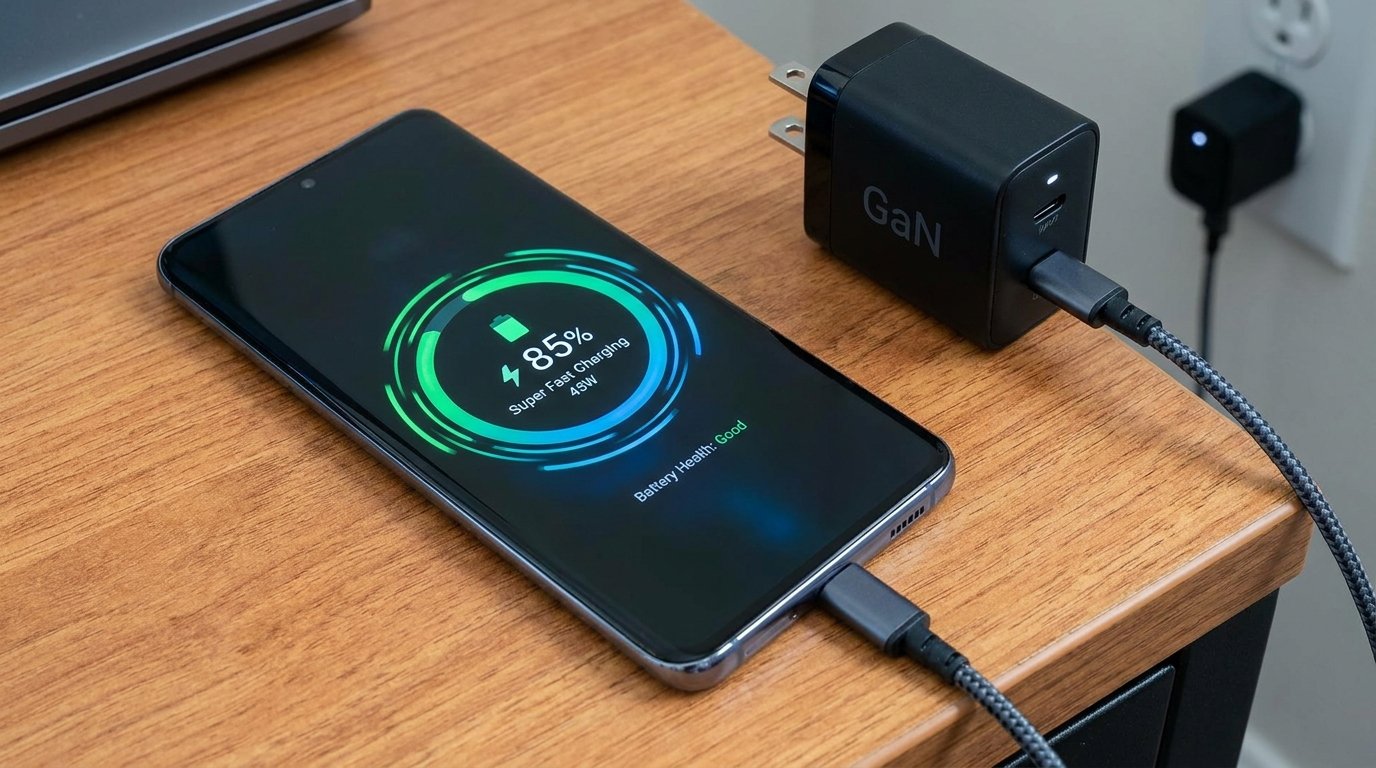
Invest in reputable third-party GaN chargers certified by safety bodies (UL, CE, USB-IF). Ensure the charger explicitly states support for USB-PD 3.0 PPS to allow your Android device to optimize dynamic power negotiation.
4. Keep Your Device Out of Extreme Temperatures
Never leave your smartphone charging under direct sunlight, on a warm vehicle dashboard, or under a pillow. If your device feels uncomfortably hot during a fast charge, remove the protective case to facilitate ambient dissipation.
Conclusion
Fast charging is one of the most practical advancements in modern smartphone technology. Thanks to open standards like USB Power Delivery 3.1, dynamic tuning via PPS, and high-efficiency GaN semiconductors, we can enjoy rapid top-ups without incurring catastrophic battery degradation. By taking advantage of built-in software charge limits and avoiding extreme heat during fast charging, you can enjoy ultra-fast charging speeds while maintaining maximum battery capacity for years to come.
